


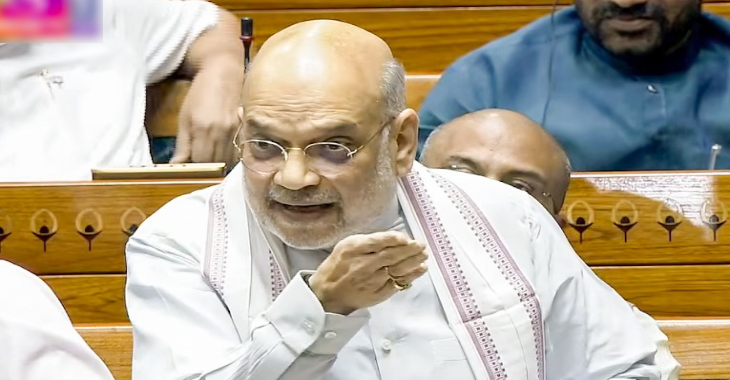
During a discussion of the no-confidence vote against Speaker Om Birla on Wednesday, Union Home Minister Amit Shah told the Lok Sabha that previous precedents refute the Opposition’s assertions about the nomination of a Deputy Speaker.
According to HM Shah, the Deputy Speaker presided over the proceedings on the three occasions in parliamentary history when a no-confidence resolution was filed against the Speaker of the Lok Sabha. He cited historical examples that demonstrated a distinct pattern of behavior by prior governments in response to the Opposition’s allegation that the government had not nominated a Deputy Speaker.
He cited incidents from both 1966 and 1987. He claimed that a Deputy Speaker was in office on both occasions and that the post was not open. He did, however, clarify that the position had been filled by members of the Congress.
According to HM Shah, the Congress currently claims the role of Deputy Speaker as its own, although historical records show that the party held the position with its own members during its rule. Therefore, he contended, the Opposition lacks the moral authority to bring up the subject of the position’s vacancy.
The Home Minister went on to say that the Congress had even appointed a member of the ruling party to a position that they claimed was intended for the Opposition. This, he said, was the “character” of the Congress when it was in power.
HM Shah gave instances, stating that M.A. Ayyangar, a member of the Congress, held the position in 1954. He further mentioned that Krishnamoorthy Rao, a member of Congress, held the position of Deputy Speaker in 1966.
According to HM Shah, in contrast to previous governments that filled the office with members of their own parties, the current government has kept it open, suggesting room for the opposition.
HM Shah went on to compare Birla’s behavior to that of other Speakers, pointing out that Speakers had held the chair for up to 14 days during Congress governments despite being the target of a no-confidence motion. On the other hand, he claimed that Birla resigned from the House’s chair immediately upon the motion’s submission due to moral concerns, and she hasn’t held the position while the motion is being considered.
“Unlike earlier instances, the present Speaker left the Chair immediately after the notice and will return only after the House decides on the motion,” HM Shah said.
Shah highlighted a wider difference between the BJP and the Congress in terms of parliamentary behavior, pointing out that throughout the previous 70 years, the BJP had not participated in any of the three no-confidence moves against Speakers of the Lok Sabha.
“In none of the motions was the BJP involved because we believe in upholding parliamentary principles and maintaining the sanctity of the Chair. The Samajwadi Party and the Communist Party were the ones who brought notices against the Chair during Congress-led governments, and today they are all sitting with the Congress,” HM Shah remarked.
More than 100 parliamentarians are said to have supported the opposition MPs’ February no-confidence notice against Lok Sabha Speaker Om Birla.
Citing the suspension of multiple Opposition MPs and the denial of speaking time to some members, including Leader of the Opposition Rahul Gandhi, opposition parties have accused the Speaker of biased behavior.
Article 94 of the Constitution, which addresses the vacation, resignation, and removal of the Speaker and Deputy Speaker of the Lok Sabha, is the basis for the proposal. No Lok Sabha Speaker has ever been removed from office since Independence, despite the fact that the Constitution permits the removal of the Speaker through a motion approved by a majority of the House.
In the past, there have been three unsuccessful attempts to remove a Speaker.
In 1954, J.B. Kripalani, the head of the Praja Socialist Party (PSP), proposed a resolution criticizing G.V. Mavalankar, the first Speaker of the Lok Sabha, but the House rejected it following discussion.
SP MPs filed a notice against Speaker Sardar Hukam Singh in 1966, but it was not supported by the necessary number of MPs.
A resolution against Speaker Balram Jakhar was proposed by CPI(M) leader Somnath Chatterjee in 1987, however it was similarly rejected following debate in the House.
Read More
Months after IndiGo’s worst-ever flight catastrophe, CEO Pieter Elbers steps down