


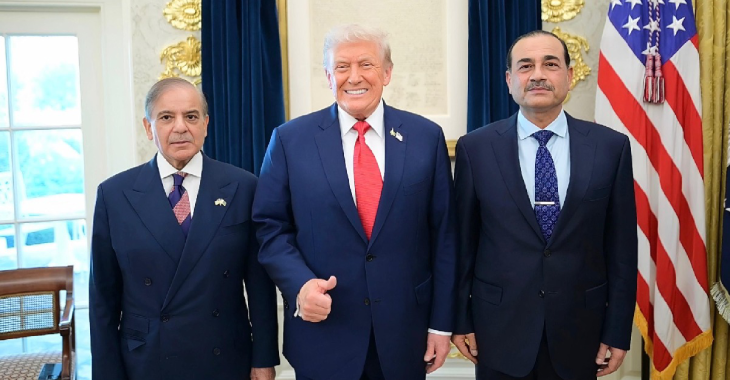
After Pakistani Army Chief Asim Munir committed soldiers to back US President Donald Trump’s high-risk Gaza stabilization operation, Pakistan’s long-used strategy of “hoodwinking” runs the risk of producing declining benefits in a more transactional and leader-centric United States.
According to a report on Saturday, Munir’s demands for tenure, investment, and indulgence over Imran Khan could quickly erode if Trump starts to consider him as another “unreliable partner” who is prepared to make concessions but avoiding delivery.
“President Donald Trump’s risky Gaza stabilization initiative and Field Marshal Asim Munir’s rise to become Pakistan’s most powerful military leader in decades have created the ideal conditions for a transactional understanding between Rawalpindi and Washington. According to a report in the UAE-based Al Arabiya Post, Munir provides Pakistani boots for Trump’s proposed International Stabilization Force (ISF) in Gaza, while the US provides political cover, economic lifelines, and indulgence for his domestic crackdown, particularly against Imran Khan and the Pakistan Tehreek-e-Insaf (PTI).
“Yet, as pressure mounts, Pakistan’s familiar act of over‑promising and under‑delivering appears to be re‑emerging, with Munir dragging his feet on ISF commitments while extracting maximum geopolitical rent,” it stated.
The research claims that Munir’s current power is based on a subservient civilian façade in Islamabad, firm institutional control over the military and intelligence apparatus, and the deliberate weakening of Imran Khan’s political challenge.
“His elevation to Field Marshal, consolidation of authority over all three services, and ruthless suppression of PTI after the May 9, 2023, unrest have turned him into Pakistan’s de facto ruler, but also into the single point of blame for economic hardship, political repression, and strategic setbacks such as the humiliation of India’s Operation Sindoor,” it continued.
According to the story, Munir now views outside support as a need rather than a luxury, which is why he needs three guarantees from Washington.
“First, unspoken support for keeping his enormous powers and extending his term beyond the customary institutional standards. Second, economic assistance and investment to support Pakistan’s faltering economy and offer a narrative of “rescue through strategic alignment,” as seen by recent Memorandums of Understanding between the US and Pakistan on energy and mineral projects. Third, a disregard for Imran Khan’s physical seclusion, media blackout, and legal persecution, which many observers now characterize as the primary victim of a military-engineered political cleansing,” it explained.
According to the paper, Washington would have to decide whether to engage Pakistan more directly over unfulfilled commitments or dilute the ISF concept by depending on a smaller, less credible coalition if Munir keeps stalling. Both options come with significant implications.
It claimed that “the Faustian bargain,” which offered the head of the Pakistani Army “external protection in exchange for Gaza may yet collapse, leaving him overexposed at home and increasingly distrusted abroad.”
Read More
Under a new rule, the US targets alleged manipulation in the H-1B system