


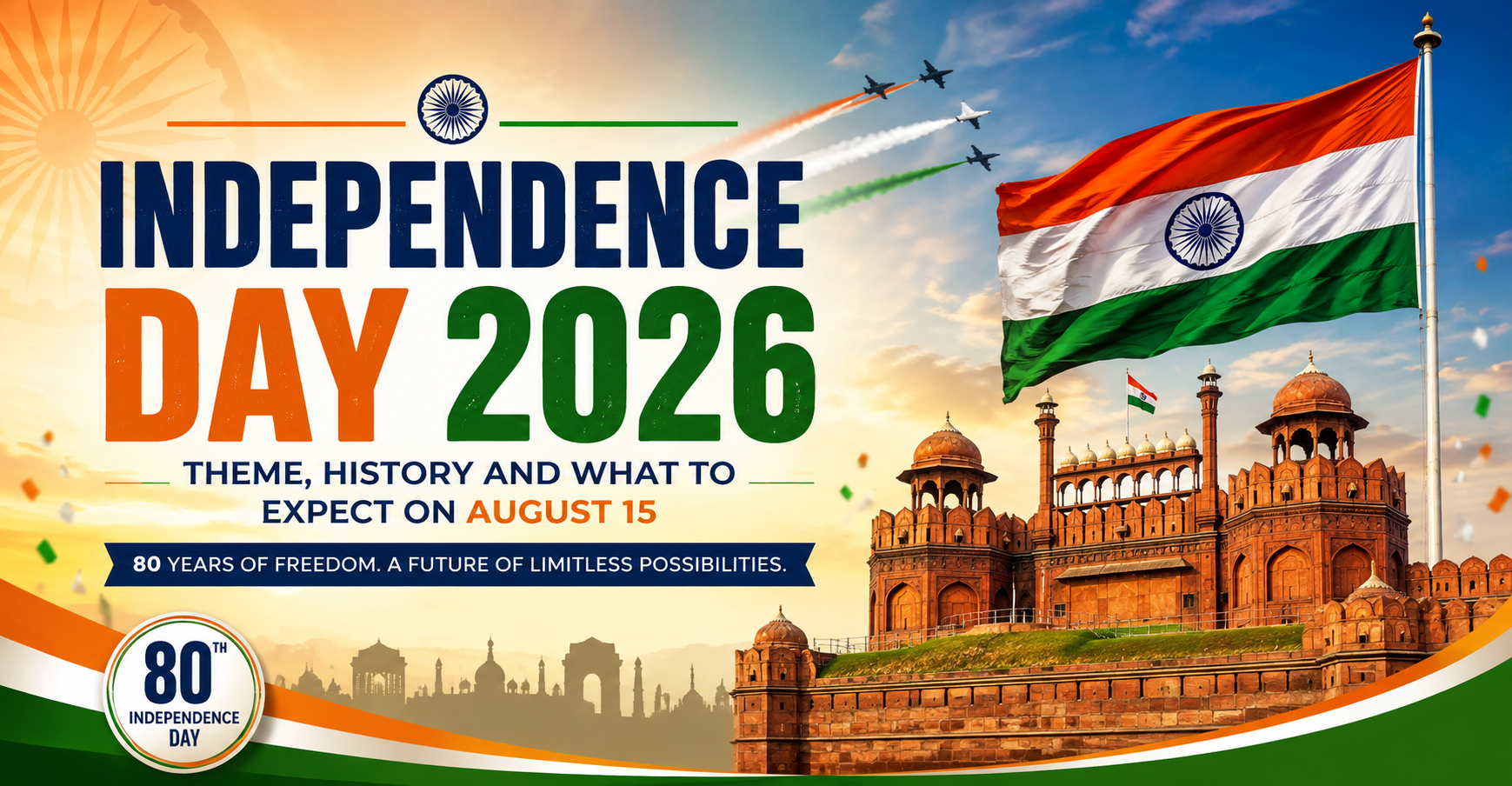
India will celebrate its 80th Independence Day on August 15, 2026, marking 79 years since the country became independent from British colonial rule in 1947. The milestone comes with a strong focus on India’s young population, national development and the country’s long-term vision of becoming a developed nation by 2047.
Every year, Independence Day serves as more than a national holiday. It is an occasion to remember the freedom struggle, honour those who sacrificed their lives for independence and reflect on India’s progress since 1947. In 2026, the celebrations are expected to combine these historical memories with a forward-looking message centred on youth, development, technology and national participation.
The main national ceremony will take place at the Red Fort in New Delhi, where Prime Minister Narendra Modi is scheduled to lead the 80th Independence Day celebrations and address the nation.
Independence Day 2026: What is the theme?
The theme of India’s Independence Day celebrations in 2026 is “Yuva Shakti for Viksit Bharat@2047.” The theme places India’s youth at the centre of the country’s development journey and connects the celebrations with the broader objective of building a developed India by 2047.
The emphasis on youth is significant because India has one of the world’s largest young populations. Young Indians are increasingly influencing entrepreneurship, technology, manufacturing, innovation, sports, research and the digital economy.
The 2026 celebrations will also commemorate 150 years of “Vande Mataram,” adding another important cultural and historical dimension to the occasion. According to the government, “Vande Mataram” will be sung when the Prime Minister arrives at the Red Fort.
Together, these themes connect India’s historical freedom movement with its future ambitions: remembering the past while encouraging younger generations to contribute to the country’s development.
Why is 2026 the 80th Independence Day?
A common question surrounding this year’s celebration is whether India is observing its 79th or 80th Independence Day.
The answer is 80th Independence Day.
India became independent on August 15, 1947. Therefore, August 15, 2026, marks the 80th anniversary of that historic event. At the same time, the country has completed 79 years of independence.
This distinction can sometimes cause confusion. The first Independence Day in 1947 is counted as the first, making 2026 the 80th Independence Day.
The history behind August 15
India’s Independence Day is rooted in a freedom movement that developed over several decades against British colonial rule.
British influence in India expanded considerably during the 18th and 19th centuries, eventually placing large parts of the Indian subcontinent under colonial administration. Economic exploitation, political restrictions and discriminatory policies contributed to growing resistance.
The Indian National Congress, established in 1885, became an important platform for political mobilisation. Over time, the freedom movement evolved from constitutional demands for greater representation into a mass movement seeking complete independence.
The struggle involved leaders and movements with different approaches. Mahatma Gandhi’s philosophy of non-violence and civil disobedience played a major role, particularly through movements such as the Non-Cooperation Movement, Civil Disobedience Movement and Quit India Movement.
Other leaders and revolutionaries also contributed to the independence movement. Figures such as Subhas Chandra Bose, Bhagat Singh, Sardar Vallabhbhai Patel, Jawaharlal Nehru, Bal Gangadhar Tilak, Lala Lajpat Rai, Sarojini Naidu and many others became associated with different phases and forms of the struggle.
Millions of ordinary Indians also participated, making independence a mass national movement rather than an effort limited to political leaders.
From the freedom struggle to independence
The Second World War significantly changed the political situation surrounding British rule in India. Economic pressures, political mobilisation and growing demands for self-government intensified the pressure on Britain.
After years of negotiations and political developments, the British government agreed to transfer power.
The Indian Independence Act of 1947 provided the legal framework for the creation of two independent dominions, India and Pakistan.
India became independent on August 15, 1947, ending nearly two centuries of British colonial rule. The transition, however, was accompanied by the Partition of British India, resulting in enormous displacement, communal violence and loss of life.
This complicated history is an important part of Independence Day. The occasion represents freedom and national achievement, but it also carries memories of the human cost associated with Partition.
Jawaharlal Nehru and the historic midnight moment
The night of August 14-15, 1947, remains one of the defining moments in modern Indian history.
India’s first Prime Minister, Jawaharlal Nehru, delivered his famous “Tryst with Destiny” speech as the country entered independence.
The speech captured the significance of the moment and the responsibilities that accompanied freedom. India was not simply celebrating the end of colonial rule; it was beginning the difficult task of building a democratic nation.
On August 15, 1947, Nehru also raised the Indian national flag at the Red Fort in Delhi. The event established a tradition that continues to define India’s Independence Day celebrations.
Why the Red Fort is important
The Red Fort has become one of the most recognisable symbols of India’s Independence Day.
Every year, the Prime Minister addresses the nation from the historic monument after unfurling the national flag. The ceremony combines military traditions, cultural elements and national symbolism.
The choice of the Red Fort is deeply connected to India’s transition from colonial rule to sovereignty. Since the first Independence Day in 1947, the monument has served as the backdrop for the Prime Minister’s annual Independence Day address.
In 2026, Prime Minister Narendra Modi will lead the national ceremony from the Red Fort. Government preparations have already been announced for the 80th Independence Day celebrations.
What to expect on August 15, 2026
The main Independence Day ceremony is expected to follow the traditional sequence of events at the Red Fort.
Flag unfurling and national anthem
The Prime Minister will unfurl the national flag at the Red Fort. The ceremony will be accompanied by the national anthem and ceremonial proceedings.
The Tricolour remains the central symbol of the occasion, representing India’s sovereignty, unity and national identity.
Prime Minister’s address
One of the most anticipated events will be the Prime Minister’s Independence Day speech.
The address traditionally covers India’s achievements over the previous year, major government priorities, economic and social development, national security, infrastructure, technology and future goals.
Given the 2026 theme, youth empowerment and the vision of Viksit Bharat@2047 are likely to receive particular attention.
The speech is also expected to reflect on India’s progress since independence and the responsibilities associated with the next stage of national development.
“Vande Mataram” and its 150-year milestone
A special feature of the 2026 celebrations will be the commemoration of 150 years of Vande Mataram.
The song has played an important role in India’s cultural and nationalist history. Its inclusion in this year’s ceremony connects the Independence Day celebration with a major historical milestone.
The government has stated that “Vande Mataram” will be sung upon the Prime Minister’s arrival at the Red Fort.
Participation of special guests
The 2026 celebrations will also include citizens representing different sections of Indian society.
Among those invited as special guests are beneficiaries associated with the PM Vishwakarma scheme. Their participation reflects the government’s effort to showcase artisans and traditional workers as contributors to India’s economic development.
Such participation adds a broader citizen-focused dimension to the national ceremony, moving beyond government officials and political representatives.
The role of India’s youth in Independence Day 2026
The choice of “Yuva Shakti for Viksit Bharat@2047” as the theme reflects the importance of India’s younger generation in the country’s long-term ambitions.
India’s development over the next two decades will depend heavily on its ability to provide young people with quality education, employment opportunities, entrepreneurial support and access to technology.
Young Indians are already active in areas such as artificial intelligence, startups, space technology, biotechnology, renewable energy, digital services and advanced manufacturing.
The theme therefore presents youth not simply as beneficiaries of development but as participants and drivers of it.
By 2047, India will mark 100 years of independence. The 2026 celebrations arrive at an important point on that journey, with roughly two decades remaining to achieve the country’s stated vision of becoming a developed nation.
Technology and a changing India
Technology is expected to remain an important part of India’s development narrative during the 2026 celebrations.
Over the past decade, India has expanded its digital infrastructure, digital payments ecosystem, online public services and technology-driven businesses.
The country’s technology ambitions now extend beyond consumer applications. Artificial intelligence, semiconductor manufacturing, electronics production, space technology, renewable energy and advanced manufacturing are becoming increasingly important areas of national strategy.
For younger Indians, these developments also create opportunities to participate in emerging industries.
The Independence Day message in 2026 is therefore likely to connect patriotism with innovation and national development, encouraging citizens to view India’s future as a collective responsibility.
Independence Day celebrations across India
While the Red Fort ceremony receives national attention, Independence Day is celebrated across the country.
State governments, schools, colleges, government offices, armed forces institutions and local organisations conduct flag-hoisting ceremonies, cultural programmes and patriotic events.
Schools often organise:
- Flag-hoisting ceremonies
- Patriotic songs and dances
- Essay and speech competitions
- Drawing and poster competitions
- Cultural performances
- Quiz competitions
- Freedom-fighter tributes
- Community activities
Many residential communities and private organisations also organise their own celebrations.
The Har Ghar Tiranga initiative has further encouraged citizens to participate in Independence Day by displaying the national flag at their homes and engaging with patriotic activities. The Prime Minister has urged people to participate in the movement in the run-up to the 2026 celebrations.
The significance of the Tricolour
The Indian national flag is one of the most powerful symbols associated with Independence Day.
The design of India’s national flag was adopted by the Constituent Assembly on July 22, 1947, shortly before independence.
The saffron, white and green bands, along with the Ashoka Chakra, represent important ideals associated with India’s national identity.
On Independence Day, the Tricolour is displayed across public institutions, schools, homes and public spaces.
However, the flag’s significance goes beyond decoration. It represents India’s sovereignty, unity and democratic journey.
Independence Day and India’s journey since 1947
The significance of August 15 can also be understood by looking at India’s transformation since independence.
In 1947, India faced enormous challenges. The country had experienced colonial exploitation, Partition, widespread poverty and low levels of industrialisation and infrastructure.
Since then, India has built democratic institutions, expanded its economy, developed scientific and technological capabilities and established itself as a major global economy.
India’s space programme, information technology sector, pharmaceutical industry, manufacturing capabilities and digital public infrastructure are examples of areas in which the country has developed substantial capacity.
At the same time, the journey remains unfinished.
Issues such as employment, inequality, education, healthcare, environmental sustainability and regional development continue to shape India’s national priorities.
That makes Independence Day both a celebration and an opportunity for reflection.
Independence Day 2026: Looking towards 2047
The year 2047 has increasingly become a reference point in India’s development narrative because it will mark 100 years of independence.
The Viksit Bharat@2047 vision seeks to frame India’s development over the long term. The 2026 theme, with its emphasis on youth, places the next generation at the centre of this vision.
For today’s students, young professionals, entrepreneurs and innovators, 2047 represents a future that they will actively shape.
This makes the 2026 Independence Day celebration particularly relevant to young Indians. The central question is no longer only how India achieved freedom, but how the country can use that freedom to create opportunity, prosperity and inclusive development.
Independence Day is more than a celebration
Independence Day has evolved significantly since 1947, but its core purpose remains unchanged: remembering the struggle for freedom and recognising the sacrifices that made independence possible.
The 2026 celebration adds another layer to that tradition.
The 80th Independence Day comes at a time when India is positioning itself as a major economic, technological and geopolitical power. The country is also preparing for its centenary of independence in 2047.
The theme “Yuva Shakti for Viksit Bharat@2047” reflects that transition from remembering the achievements of previous generations to preparing the next generation for its responsibilities.
On August 15, the Tricolour will once again rise above the Red Fort. The Prime Minister’s address will provide an opportunity to look back at India’s journey, assess the present and outline ambitions for the future.
For millions of Indians, however, Independence Day will remain deeply personal. It will be celebrated in schools, workplaces, homes and communities through flags, songs, speeches and cultural programmes.
Ultimately, Independence Day 2026 is a reminder that freedom is not only a historical achievement. It is an ongoing responsibility.
As India moves towards 100 years of independence in 2047, the country’s young population will have a defining role in determining what the next chapter looks like. The 80th Independence Day therefore stands at the intersection of history and ambition—honouring the sacrifices of the past while looking ahead to the India of tomorrow.
Read More
Top 10 Pharmaceutical Startups Revolutionizing Healthcare
Why the FIFA World Cup is the Biggest Sporting Event on Earth