


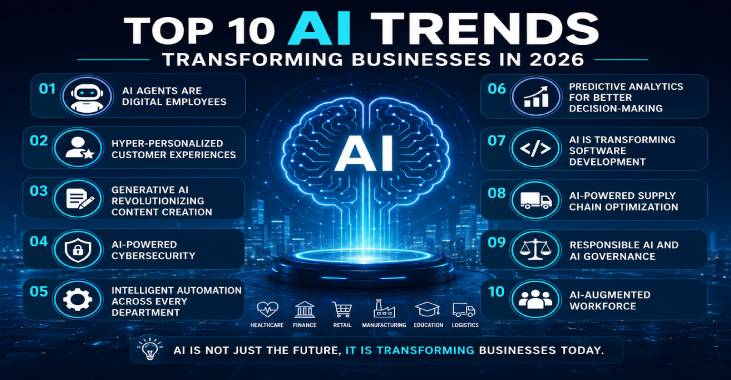
Artificial Intelligence (AI) has evolved from being an emerging technology to becoming a critical driver of business transformation. In 2026, organizations of all sizes—from startups to multinational enterprises—are leveraging AI to improve efficiency, enhance customer experiences, reduce operational costs, and gain a competitive advantage.
The rapid advancement of generative AI, autonomous AI agents, predictive analytics, and intelligent automation is changing how businesses operate across industries such as healthcare, finance, retail, manufacturing, education, and logistics.
This article explores the Top 10 AI trends transforming businesses in 2026 and explains why organizations should embrace these innovations to stay ahead in an increasingly digital world.
1. AI Agents Are Becoming Digital Employees
One of the biggest trends in 2026 is the rise of AI agents. Unlike traditional chatbots that simply answer questions, AI agents can perform complex tasks with minimal human intervention.
Modern AI agents can:
- Schedule meetings
- Generate reports
- Analyze large datasets
- Send emails
- Manage workflows
- Write software code
- Conduct research
- Handle customer support
Businesses are integrating AI agents into daily operations to reduce repetitive work and allow employees to focus on strategic decision-making.
Benefits include:
- Higher productivity
- Reduced operational costs
- Faster task completion
- Improved customer service
AI agents are quickly becoming valuable digital teammates rather than simple software tools.
2. Hyper-Personalized Customer Experiences
Customers today expect personalized experiences across websites, mobile apps, and customer service channels.
AI helps businesses understand customer behavior by analyzing:
- Purchase history
- Browsing habits
- Preferences
- Demographics
- Feedback
- Social interactions
Using these insights, companies can provide:
- Personalized product recommendations
- Customized marketing campaigns
- Dynamic pricing
- Personalized emails
- Tailored customer support
Retailers, streaming platforms, banks, and e-commerce businesses are using AI personalization to improve customer satisfaction and increase sales.
Businesses that deliver personalized experiences often see stronger customer loyalty and higher conversion rates.
3. Generative AI Is Revolutionizing Content Creation
Generative AI has become an essential business tool in 2026.
Organizations use AI to create:
- Blog articles
- Marketing copy
- Product descriptions
- Social media posts
- Training materials
- Presentations
- Images
- Videos
- Software code
Instead of replacing creative professionals, AI acts as a productivity partner.
Marketing teams can now create campaigns much faster while maintaining consistency across platforms.
Businesses also use AI to:
- Translate content
- Summarize reports
- Create meeting notes
- Generate technical documentation
This dramatically reduces production time and costs.
4. AI-Powered Cybersecurity
Cybersecurity threats continue to evolve rapidly.
Businesses now rely on AI to detect attacks before they cause significant damage.
AI systems monitor:
- Network traffic
- User behavior
- Login attempts
- Device activity
- System performance
When unusual behavior is detected, AI can immediately:
- Alert security teams
- Block suspicious activity
- Isolate infected systems
- Recommend security actions
Machine learning models continuously improve by learning from previous attacks.
As cybercriminals increasingly use AI themselves, organizations are investing heavily in AI-powered security solutions to protect sensitive data.
5. Intelligent Automation Across Every Department
Automation is no longer limited to manufacturing.
Businesses now automate processes in:
- Human Resources
- Finance
- Procurement
- Customer Support
- Legal
- Marketing
- Supply Chain
- IT Operations
Examples include:
- Invoice processing
- Employee onboarding
- Payroll
- Expense approvals
- Resume screening
- Customer ticket routing
- Document verification
Combining robotic process automation (RPA) with AI creates intelligent automation capable of handling more complex business processes.
This allows employees to focus on innovation instead of repetitive administrative tasks.
6. Predictive Analytics for Better Decision-Making
Businesses generate enormous amounts of data every day.
AI transforms this data into actionable insights through predictive analytics.
Predictive AI helps organizations forecast:
- Customer demand
- Sales trends
- Equipment failures
- Inventory needs
- Market changes
- Financial risks
Instead of reacting to problems after they occur, businesses can proactively make informed decisions.
Examples include:
- Retailers forecasting seasonal demand
- Manufacturers predicting machine maintenance
- Banks identifying loan risks
- Hospitals anticipating patient volumes
Better predictions lead to improved planning and reduced operational risks.
7. AI Is Transforming Software Development
Software development has changed dramatically.
Developers now use AI to:
- Generate code
- Detect bugs
- Write unit tests
- Review pull requests
- Generate documentation
- Explain legacy code
- Improve code quality
AI coding assistants significantly reduce development time while helping teams maintain consistency.
Benefits include:
- Faster development cycles
- Fewer coding errors
- Improved developer productivity
- Easier onboarding for new developers
Rather than replacing developers, AI enables them to spend more time solving complex business problems.
8. AI-Powered Supply Chain Optimization
Global supply chains remain complex and unpredictable.
AI helps businesses improve logistics by analyzing:
- Weather conditions
- Shipping delays
- Fuel prices
- Customer demand
- Inventory levels
- Transportation routes
AI enables companies to:
- Optimize warehouse operations
- Reduce delivery times
- Lower transportation costs
- Predict supply shortages
- Improve inventory management
Manufacturers and retailers benefit from greater efficiency while minimizing waste and operational disruptions.
9. Responsible AI and AI Governance
As AI adoption increases, organizations are placing greater emphasis on responsible AI.
Businesses are implementing governance frameworks to ensure AI systems are:
- Transparent
- Fair
- Secure
- Accountable
- Ethical
Key priorities include:
- Reducing algorithmic bias
- Protecting customer privacy
- Explaining AI-generated decisions
- Monitoring AI performance
- Complying with regulations
Customers increasingly trust companies that demonstrate responsible AI practices.
AI governance is becoming a business necessity rather than an optional initiative.
10. AI-Augmented Workforce
One of the biggest misconceptions is that AI replaces human workers.
In reality, AI is augmenting employees rather than replacing them.
Workers use AI to:
- Research information
- Prepare presentations
- Analyze data
- Generate reports
- Write emails
- Brainstorm ideas
- Automate repetitive work
Organizations are investing in employee AI training programs to improve productivity and digital skills.
The future workplace is built around collaboration between humans and AI.
Employees who learn AI tools become more productive and valuable to their organizations.
Industries Being Transformed by AI
Almost every industry is experiencing AI-driven transformation.
Healthcare
- Faster diagnostics
- Medical imaging analysis
- Patient monitoring
- Drug discovery
Finance
- Fraud detection
- Credit scoring
- Investment analysis
- Risk management
Retail
- Personalized recommendations
- Inventory forecasting
- Dynamic pricing
- Customer analytics
Manufacturing
- Predictive maintenance
- Quality inspection
- Robotics
- Production optimization
Education
- Personalized learning
- Automated assessments
- AI tutoring
- Administrative automation
Logistics
- Route optimization
- Fleet management
- Warehouse automation
- Demand forecasting
Challenges Businesses Must Address
Despite its benefits, AI adoption comes with several challenges:
- Data privacy concerns
- Cybersecurity risks
- Ethical considerations
- Regulatory compliance
- High implementation costs
- Employee skill gaps
- Integration with legacy systems
- Model accuracy and reliability
Organizations that invest in governance, employee training, and strong security practices will be better positioned to overcome these challenges.
Preparing Your Business for the AI Future
Businesses looking to succeed with AI should:
- Identify repetitive processes suitable for automation.
- Invest in high-quality, well-governed data.
- Train employees to work effectively with AI tools.
- Establish ethical AI guidelines and governance.
- Begin with small pilot projects and scale successful initiatives.
- Continuously monitor AI performance and outcomes.
- Foster a culture of innovation and continuous learning.
A thoughtful, phased approach helps organizations maximize AI’s benefits while managing risks.
Conclusion
Artificial Intelligence is no longer a futuristic concept—it is a foundational technology reshaping how businesses operate in 2026. From AI agents and intelligent automation to predictive analytics, cybersecurity, and personalized customer experiences, AI is enabling organizations to become faster, smarter, and more competitive.
However, successful AI adoption is not just about implementing new technology. It also requires responsible governance, skilled employees, high-quality data, and a clear business strategy. Companies that embrace these trends while maintaining ethical and transparent AI practices will be well-positioned for long-term success.
As AI continues to evolve, businesses that invest today in innovation, workforce upskilling, and digital transformation will be better equipped to navigate future challenges and seize new opportunities. In the years ahead, AI will not simply support business operations—it will become an integral partner in driving growth, innovation, and sustainable competitive advantage.
Read More
Best IPL Matches That Changed Cricket History
Top 10 Indian Fashion Influencers to Follow in 2025