


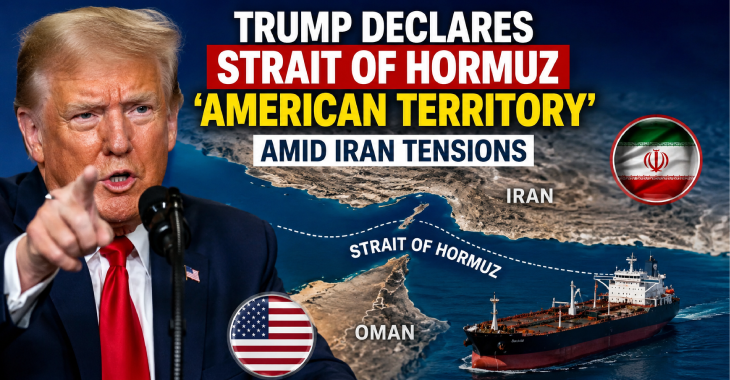
US President Donald Trump has intensified the confrontation with Iran by saying that he currently views the strategically important Strait of Hormuz as “American territory,” adding a new and controversial dimension to the growing tensions between Washington and Tehran.
Trump made the remarks during a campaign rally in Myrtle Beach, South Carolina, as he discussed the continuing confrontation with Iran and his administration’s efforts to prevent Tehran from developing nuclear weapons. He also suggested that Iran was eager to reach an agreement with Washington but questioned whether the United States would accept a deal at this stage.
“We cannot let Iran have a nuclear weapon,” Trump said, reiterating his position that Iran must not be allowed to acquire such capabilities. He then turned to the Strait of Hormuz, one of the world’s most important energy and shipping routes, and said he viewed the waterway as American territory “right now.”
The statement has generated immediate international attention because the Strait of Hormuz is not US territory. The narrow waterway lies between Iran and Oman and connects the Persian Gulf with the Gulf of Oman and the Arabian Sea. It is a critical route for international energy supplies, with a significant share of the world’s seaborne oil shipments traditionally passing through the strait.
Rising US-Iran Tensions
Trump’s comments come amid an increasingly serious confrontation between the United States and Iran. Washington has imposed a military blockade affecting Iranian shipping, while negotiations between the two countries have struggled to produce a lasting agreement.
US officials have said American forces have taken steps to control or redirect commercial shipping in the area. According to recent reports, dozens of commercial vessels have been redirected because of the security situation around the waterway.
Trump has also maintained that Iran must never be permitted to obtain a nuclear weapon. His latest remarks suggest that Washington intends to maintain strong pressure on Tehran while negotiations remain unresolved.
The Strait of Hormuz has consequently become one of the central issues in the confrontation. Any prolonged disruption of traffic through the waterway could have consequences well beyond the Middle East because of its importance to global energy markets.
Iran Rejects Trump’s Claim
Iran has strongly rejected Trump’s description of the Strait of Hormuz as American territory.
Iranian Deputy Foreign Minister Kazem Gharibabadi criticised the statement and said Trump’s assertion would ultimately be corrected. Other Iranian officials also portrayed the remarks as evidence of Washington’s increasingly aggressive position toward Tehran.
Iranian Parliament Speaker Mohammad Bagher Ghalibaf has linked any reopening of the waterway to conditions including the lifting of the US blockade, the release of frozen Iranian assets and easing of oil-related sanctions.
The Iranian response highlights the widening gap between the two sides. While Washington says pressure is necessary to prevent Iran from developing nuclear weapons and to secure shipping routes, Tehran continues to reject what it considers unacceptable US demands.
Why the Strait of Hormuz Matters
The Strait of Hormuz is one of the most strategically important waterways in the world. Its location makes it a crucial gateway for energy exports from Gulf countries to international markets.
Because large quantities of oil and other energy products normally pass through the region, instability around the strait can quickly affect global markets. Recent tensions have already contributed to higher oil prices, with Brent crude recently rising above $90 per barrel amid concerns about disruptions.
For countries that depend heavily on imported energy, prolonged uncertainty around the waterway could create additional economic pressure. Higher transportation and energy costs could also affect businesses and consumers worldwide.
What Happens Next?
Trump’s latest statement is likely to increase diplomatic pressure on Iran while making negotiations more difficult. The United States and Iran remain far apart on several major issues, including nuclear policy, sanctions, shipping and control of the strategic waterway.
Analysts have described the US position as a maximalist approach designed to increase pressure on Tehran. At the same time, the continuing standoff raises questions about how the crisis can be resolved without further destabilising the region.
For now, there is no clear indication that Washington and Tehran have reached a breakthrough. Trump says Iran wants a deal, but he has also indicated that the United States is not necessarily in a hurry to accept one.
The Strait of Hormuz therefore remains at the centre of the confrontation. Trump’s extraordinary description of the waterway as “American territory” has added further controversy to an already volatile situation, while Iran’s rejection signals that tensions between the two governments remain far from resolved.
As diplomatic efforts continue, the international community will closely monitor developments around the strait because any prolonged disruption could have consequences for energy markets, global trade and regional security.
Read More
Trump establishes a deadline for disarming Hamas
As Ukraine peace talks progress, Trump and Zelensky maintain lighthearted conversations